
by Eclipse Foundation Staff
“I see open source as a career”
For the past seven years, Theresa Seyram Agbenyegah has been growing alongside Ghana’s open source community as a developer, organiser, volunteer, mentor, and advocate. What began in 2018 with a simple invitation to a Django Girls coding workshop has grown into both a passion and a career.
Today, Theresa is an active voice in Ghana’s open source ecosystem, contributing through the Python Software Foundation and Django Software Foundation, as well as other communities such as PyLadies Ghana and Django Girls. Alongside her professional work, she continues to champion open source as a space for belonging, shared learning, and opportunity.
Interested in open source in Ghana? Read also: Joyce Dzifa Lokko: Creating opportunities in Ghana’s growing tech ecosystem
A moment of fulfilment
“I had stage fright. I see my whole body vibrating. But when I heard the other panelists, I don’t know where it vanished to. I was able to flow and connect and speak. In my mind, I was like, ‘wow, I’m doing this.’”
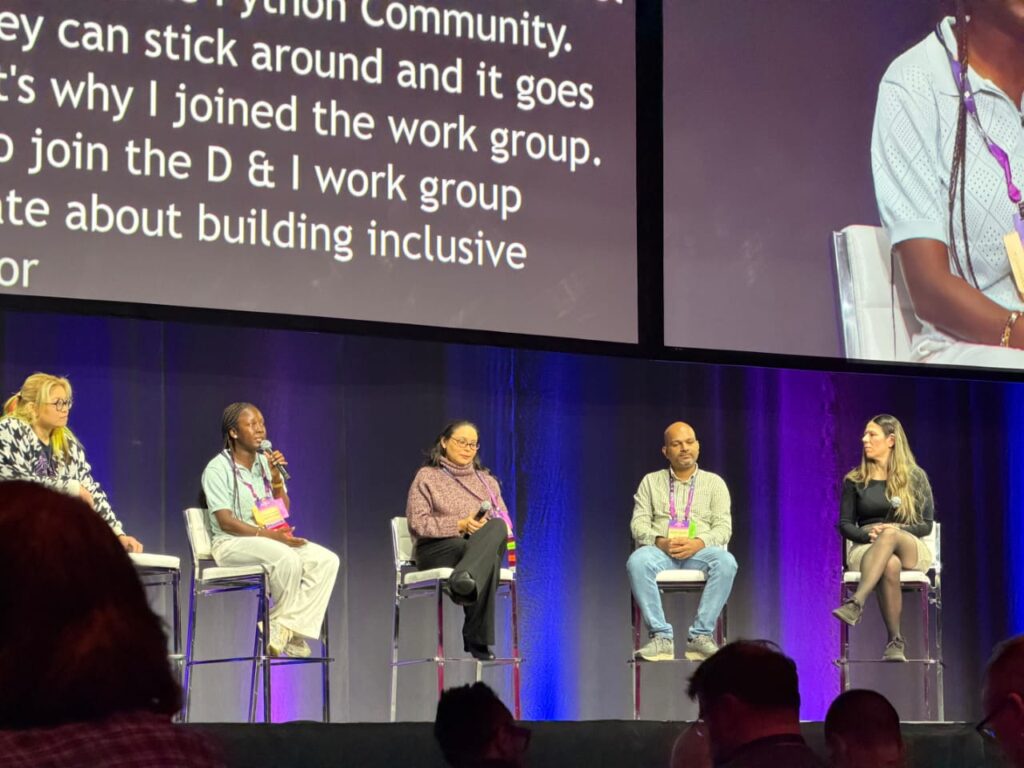
Theresa Seyram Agbenyegah spoke at PyCon US 2026 on the Diversity and Inclusion panel. Despite her initial nerves, the talk was super successful and became a core memory as Theresa’s first time speaking at an international conference.
She recalls the moment with fondness, as one that motivated her to push away her fears in order to connect with nearly 2000 attendees on-stage and dozens more in the conference halls following the session. People could relate to her experience and adapt her concept to their own projects.
Falling in love with Django, Python, and open source
Now, flash back seven years earlier: it’s April 2018, and Theresa has since finished senior high. She’s in the process of exploring post-secondary options when she’s contacted by one of her girl friends, who invites her to Django Girls Sogakope, a two-day workshop oriented towards beginners in coding, and if she has a laptop, she is more than welcome to join.
When Theresa arrives, the workshop group is conducting an introduction to CMD (the command prompt). Although previously interested in computing, Theresa discovers coding for the first time. She comes back the next day for their introduction to Python and Django.
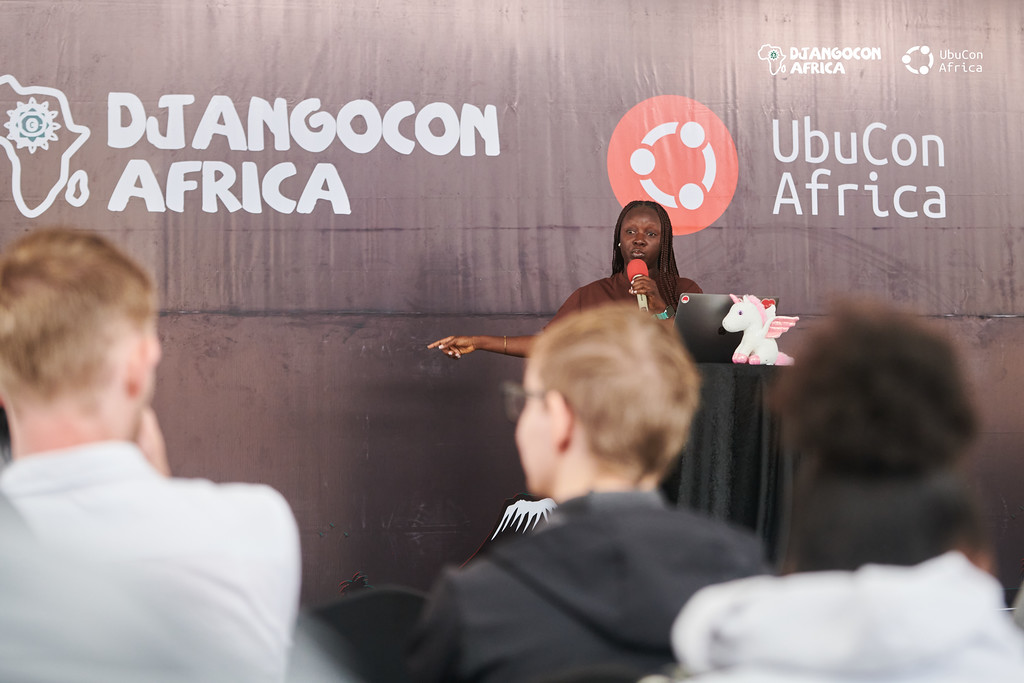
Although coding struck a chord with her, Theresa hadn’t yet dived into the open source community and stayed in contact with relatively few of those she met at the workshop. What changed that was her mentor from the workshop, Paa Jake. He continued to follow up with her through the Mentees’ platform after the workshop concluded. His persistence played a key role in her application to computer science for university.
Later that year, another workshop was being hosted, this time in Ho, where Theresa joined as a participant. There, she discovered a group called “PyLadies Ghana,” for Ghanaian women who wanted to learn Python and contribute. That was the first open source organisation of many to come that Theresa would join and later volunteer for. She joined PyLadies in Tema as a co-lead, organising meetups and events to introduce women to Python.
“That’s when I fell in love with open source: me sharing what I’ve learned firsthand with people, seeing people getting involved, getting enlightened – that’s what programming is about, what Python is about.”
Open source in Ghana: community beyond code
“It’s the community that made me who I am today. And it also gave me a sense of belonging.”
For Theresa, the technical work that is in many ways the foundation of open source remains inextricable from non-technical contributions such as outreach, accounting, marketing, and event organisation. These efforts create the possibility for conferences and face-to-face events, which nurture an empathetic, innovative community:
“Without people, there will be no open source, and there will be no community.”
PyLadies and Django Girls are only two of the numerous spaces reserved for women in tech, and Theresa notes the long-lasting connections she has been able to forge because of them:
“I’ve made amazing connections. We don’t just talk about tech stuff. We talk about life, like we’ve become a family.”
The women (and men) in these groups push each other to reach their goals, and the opportunity to work within the tightly knit Ghanaian open source community has allowed her to develop meaningful relationships with other leaders in the field.
Ghana, a country full of possibilities
“Ghana is not just full of possibilities but also of talent.”
In many ways, Ghana is still in the process of threading technology through everyday life across all regions. Just because it’s in Accra or Kumasi, doesn’t mean it’s everywhere.
“There are other places where people don’t even know what programming is. So Ghana is very special because I feel like we have a lot of opportunity for people to explore, for a lot of open source foundations to have their projects here ongoing, introducing people to open source and the various technologies needed to do it.”
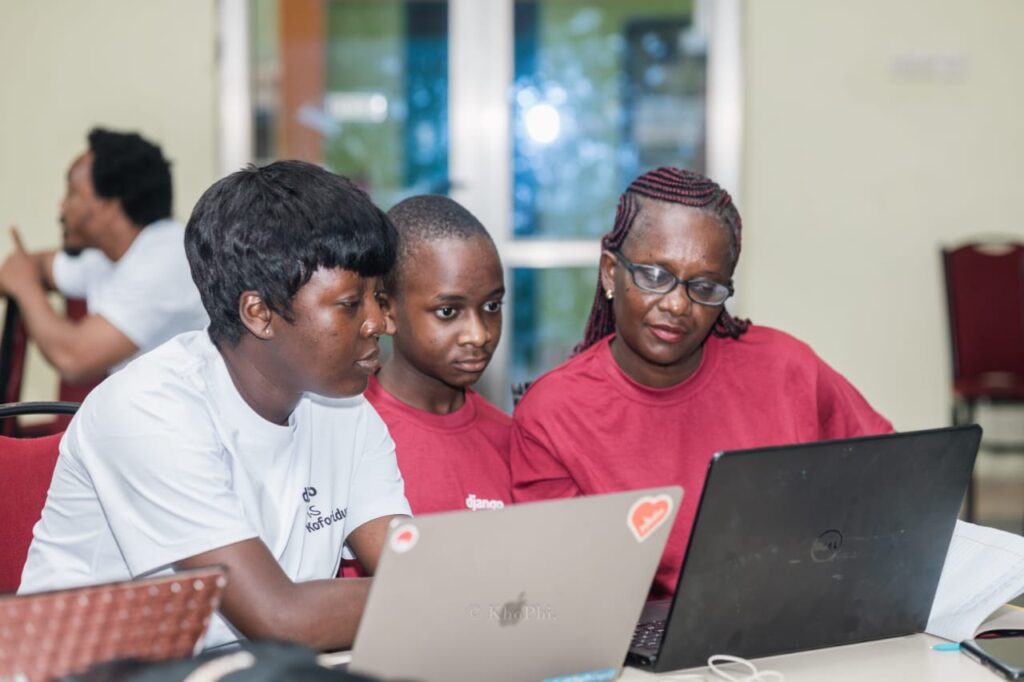
The uneven distribution of technology makes outreach efforts, like the ones Theresa frequently takes on, even more important. She notes that a growing number of projects is making it easier to spread the word and attract interest, including students and people from other regions.
Rather than viewing it as an obstacle, Theresa sees this as an opportunity. Coming from Africa has given her several occasions to offer her perspective at international conferences. She discusses how throwing her hat in the ring has resulted in more attention being brought to current African open source technologies and areas that would benefit from shared innovation:
“If you really do your research, you identify a lot of areas of need in technology. Innovations can thrive in Ghana and can also impact people.”
This also means there is an untapped wealth of talent in Ghana. Hiring opportunities are many times oriented towards the United States, Canada, and Europe, so talent in Africa can go unnoticed. Theresa advocates for Ghanaian developers:
“I’ll encourage organisations to explore developers in Ghana and take interest in them to know what they are building, what they are shipping… If they need software engineers, UI/UX designers, community managers – there are great and superb talents in Ghana who know how to bring those African vibes to the community.”
A message to open source beginners
“If you are not passionate about it, you cannot do it.”
Finally, Theresa draws on her own open source experiences to offer advice to those starting out. Two qualities she’s identified in any successful open source contributor are passion and commitment. Working in open source can sometimes be draining and overwhelming, and most open source contributors are offering their time alongside their day job, which is why Theresa raises these qualities above all others: they allow contributors to follow a project through to the end and become a reliable support to their peers.
In terms of ways to contribute, Theresa upholds non-technical contributions alongside technical ones. That’s why her advice to upcoming Ghanaian developers who want to contribute to open source begins with volunteering at conferences and getting involved. She highlights the importance of initiative and self-advocacy:
“Tell them what you can do. You meet people you are working with; you talk about work, business, continuity, emerging technologies, how to build features, and how the product can scale. You meet people working at Google, working at Amazon, talking about the technologies they are doing. That’s one of the impacts that you bring to your day job: to impact your work and reflect on it.”
Rather than seeing her open source projects as yet another job, Theresa views them as distinct:
“I see my day job as a job, then I see open source as a career.”
The interpersonal relationships she gains from open source and the growth she sees in her professional expertise wholly differentiate the experience for her.
Open source is integrated throughout almost every community and for Theresa, her participation in open source is about giving back while enjoying a sense of belonging, success, and ownership.
“Everybody needs to get involved in open source. Everybody needs to try it.”
Theresa Seyram Agbenyegah is a backend engineer, open source advocate, and community leader passionate about building scalable software and empowering developers. She volunteers with the Python Software Foundation and the Django Software Foundation, contributing to initiatives that strengthen open source communities.
Theresa enjoys mentoring developers, speaking at conferences, and creating technical content that makes complex concepts accessible. Her work focuses on fostering inclusive communities and helping more people contribute to and thrive in open source.
She also serves in leadership roles with PyLadies Ghana and PyCon Ghana, where she mentors developers and creates opportunities for greater participation in technology and open source.